|
Automatic
Programmable
Thermostats
Energy
Efficient Water Heating
Heating
Cooling Energy Tips
New
Furnance Can Reduce Heating
Costs
Test Your
Energy IQ
|
In our modern, high-tech society, we don't think much about some
of the electronic gadgets in our homes. Take, for example, the
ever-present thermostat--a staple of American households for decades.
It usually takes the shape of an unassuming box on the wall, but
that modest device controls the comfort of your family on the
coldest day in January and the hottest day in July.
What Is a Thermostat?
It is a temperature-sensitive switch that controls a space conditioning
unit or system, such as a furnace, air conditioner, or both. When
the indoor temperature drops below or rises above the thermostat
setting, the switch moves to the "on" position, and your furnace
or air conditioner runs to warm or cool the house air to the setting
you selected for your family's comfort. A thermostat, in its simplest
form, must be manually adjusted to change the indoor air temperature.
General Thermostat Operation
You can easily save energy in the winter by setting the thermostat
to 68 degrees F (20 degrees C) when you're at home and awake,
and lowering it when you're asleep or away. This strategy is effective
and inexpensive if you are willing to adjust the thermostat by
hand and wake up in a chilly house. In the summer, you can follow
the same strategy with central air conditioning, too, by keeping
your house warmer than normal when you are away, and lowering
the thermostat setting to 78 degrees F (26 degrees C) only when
you are at home and need cooling. A common misconception associated
with thermostats is that a furnace works harder than normal to
warm the space back to a comfortable temperature after the thermostat
has been set back, resulting in little or no savings. This misconception
has been dispelled by years of research and numerous studies.
The fuel required to reheat a building to a comfortable temperature
is roughly equal to the fuel saved as the building drops to the
lower temperature. You save fuel between the time that the temperature
stabilizes at the lower level and the next time heat is needed.
So, the longer your house remains at the lower temperature, the
more energy you save.
Another misconception is that the higher you raise a thermostat,
the more heat the furnace will put out, or that the house will
warm up faster if the thermostat is raised higher. Furnaces put
out the same amount of heat no matter how high the thermostat
is set--the variable is how long it must stay on to reach the
set temperature.
In the winter, significant savings can be obtained by manually
or automatically reducing your thermostat's temperature setting
for as little as four hours per day. These savings can be attributed
to a building's heat loss in the winter, which depends greatly
on the difference between the inside and outside temperatures.
For example, if you set the temperature back on your thermostat
for an entire night, your energy savings will be substantial.
By turning your thermostat back 10 degrees to 15 degrees for 8
hours, you can save about 5% to 15% a year on your heating bill--a
savings of as much as 1% for each degree if the setback period
is eight hours long. The percentage of savings from setback is
greater for buildings in milder climates than for those in more
severe climates. In the summer, you can achieve similar savings
by keeping the indoor temperature a bit higher when you're away
than you do when you're at home.
But there is a certain amount of inconvenience that results from
manually controlling the temperature on your thermostat. This
includes waking up in a cooler than normal house in the winter
and possibly forgetting to adjust the thermostat (during any season)
when you leave the house or go to bed.
Thermostats with Automatic Temperature Adjustment
To maximize your energy savings without sacrificing comfort, you
can install an automatic setback or programmable thermostat. They
adjust the temperature setting for you. While you might forget
to turn down the heat before you leave for work in the morning,
a programmable thermostat won't! By maintaining the highest or
lowest required temperatures for four or five hours a day instead
of 24 hours, a programmable thermostat can pay for itself in energy
saved within four years.
Programmable thermostats have features with which you may be
unfamiliar. The newest generation of residential thermostat technologies
is based on microprocessors and thermistor sensors. Most of these
programmable thermostats perform one or more of the following
energy control functions:
They store and repeat multiple daily settings, which you can
manually override without affecting the rest of the daily or weekly
program.
They store six or more temperature settings a day.
They adjust heating or air conditioning turn-on times as the
outside temperature changes. Most programmable thermostats have
liquid crystal temperature displays. Some have back-up battery
packs that eliminate the need to reprogram the time or clock in
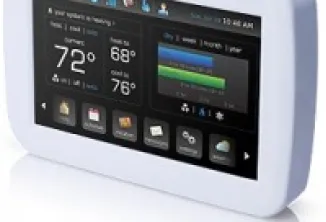
case of a power failure. New programmable thermostats can be programmed
to accommodate life style and control heating and cooling systems
as needed
A Note for Heat Pump Owners
When a heat pump is in its heating mode, setting back a conventional
heat pump thermostat can cause the unit to operate inefficiently,
thereby canceling out any savings achieved by lowering the temperature
setting. Maintaining a moderate setting is the most cost-effective
practice. Recently, however, some companies have begun selling
specially designed setback thermostats for heat pumps, which make
setting back the thermostat cost effective. In its cooling mode,
the heat pump operates like an air conditioner; therefore, manually
turning up the thermostat will save you money.
Types of Automatic and Programmable Thermostats
There are five basic types of automatic and programmable thermostats:
- electromechanical
- digital
- hybrid
- occupancy
- light sensing
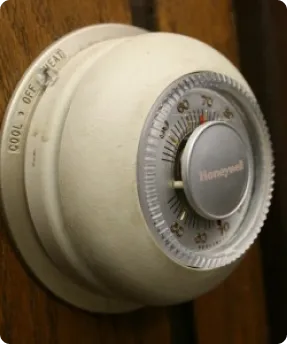
Electromechanical (EM) thermostats, usually the easiest devices
to operate, typically have manual controls such as movable tabs
to set a rotary timer and sliding levers for night and day temperature
settings. These thermostats work with most conventional heating
and cooling systems, except heat pumps. EM controls have limited
flexibility and can store only the same settings for each day,
although at least one manufacturer has a model with separate settings
for each day of the week. EM thermostats are best suited for people
with regular schedules.
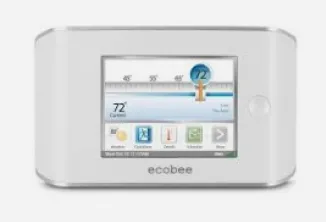
Digital thermostats are identified by their LED or LCD digital
readout and data entry pads or buttons. They offer the widest
range of features and flexibility, and digital thermostats can
be used with most heating and cooling systems. They provide precise
temperature control, and they permit custom scheduling. Programming
some models can be fairly complicated; make sure you are comfortable
with the functions and operation of the thermostat you choose.
Remember-- you won't save energy if you don't set the controls
or you set them incorrectly. Hybrid systems combine the technology
of digital controls with manual slides and knobs to simplify use
and maintain flexibility. Hybrid models are available for most
systems, including heat pumps.
Occupancy thermostats maintain the setback temperature until
someone presses a button to call for heating or cooling. They
do not rely on the time of day. The ensuing preset "comfort period"
lasts from 30 minutes to 12 hours, depending on how you've set
the thermostat. Then, the temperature returns to the setback level.
These units offer the ultimate in simplicity, but lack flexibility.
Occupancy thermostats are best suited for spaces that remain unoccupied
for long periods of time.
Light sensing heat thermostats rely on the lighting level preset
by the owner to activate heating systems. When lighting is reduced,
a photocell inside the thermostat senses unoccupied conditions
and allows space temperatures to fall 10? below the occupied temperature
setting. When lighting levels increase to normal, temperatures
automatically adjust to comfort conditions. These units do not
require batteries or programming and reset themselves after power
failures. Light sensing thermostats are designed primarily for
stores and offices where occupancy determines lighting requirements,
and therefore heating requirements.
By turning your thermostat back 10 to 15 degrees for 8 hours,
you can save 5% to 15% a year on your heating bill - a savings
of as much as 1% for each degree if the setback period is eight
hours long.
Choosing a Programmable Thermostat
Because programmable thermostats are a relatively new technology,
you should learn as much as you can before selecting a unit. When
shopping for a thermostat, bring information with you about your
current unit, including the brand and model number. Also, ask
these questions before buying a thermostat:
- Does the unit's clock draw its power from the heating system's
low-voltage electrical control circuit instead of a battery?
If so, is the clock disrupted when the furnace cycles on and
off? Battery-operated back-up thermostats are preferred by many
homeowners.
- Is the thermostat compatible with the electrical wiring found
in your current unit?
- Are you able to install it yourself, or should you hire an
electrician or a heating, ventilation, and air conditioning
(HVAC) contractor?
- How precise is the thermostat?
- Are the programming instructions easy to understand and remember?
Some thermostats have the instructions printed on the cover
or inside the housing box. Otherwise, will you have to consult
the instruction booklet every time you want to change the setback
times? Most automatic and programmable thermostats completely
replace existing units. These are preferred by many homeowners.
However, some devices can be placed over existing thermostats
and are mechanically controlled to permit automatic setbacks.
These units are usually powered by batteries, which eliminates
the need for electrical wiring. They tend to be easy to program,
and because they run on batteries, the clocks do not lose time
during power outages.
Before you buy a programmable thermostat, chart your weekly habits
including wake up and departure times, return home times, and
bedtimes, and the temperatures that are comfortable during those
times. This will help you decide what type of thermostat will
best serve your needs.
A programmable thermostat can pay for itself in energy saved
within four years.
Other Considerations
The location of your thermostat can affect its performance and
efficiency. Read the manufacturer's installation instructions
to prevent "ghost readings" or unnecessary furnace or air conditioner
cycling. Place thermostats away from direct sunlight, drafts,
doorways, skylights, and windows. Also make sure your thermostat
is conveniently located for programming.
Some modern heating and cooling systems require special controls.
Heat pumps are the most common and usually require special setback
thermostats. These thermostats typically use special algorithms
to minimize the use of backup electric resistance heat systems.
Electric resistance systems, such as electric baseboard heating,
also require thermostats capable of directly controlling 120 volt
or 240 volt line-voltage circuits. Only a few companies manufacture
line-voltage setback thermostats. A Simpler Way to Control Your
Environment
The best thermostat for you will depend on your life style and
comfort level in varying house temperatures. While automatic and
programmable thermostats save energy, a manual unit can be equally
effective if you diligently regulate its setting--and if you don't
mind a chilly house on winter mornings. If you decide to choose
an automatic thermostat, you can set it to raise the temperature
before you wake up and spare you some discomfort. It will also
perform consistently and dependably to keep your house at comfortable
temperatures during the summer heat, as well.
Source List
- The Energy Efficiency and Renewable Energy Clearinghouse (EREC)
P.O. Box 3048 Merrifield, VA 22116 (800) 363-3732 Fax: (703)
893-0400
- EREC provides free general and technical information to the
public on the many topics and technologies pertaining to energy
efficiency and renewable energy.
Reading List
- "Electronic Thermostats," Radio-Electronics, June 1992.
- "Energy Saving Thermostats," Consumer Reports, October 1993."
- "Good News on the 'Setback' Front," T. Wilson, Home Energy,
Jan-Feb 1991. 2124 Kittredge Street, No. 95, Berkeley, CA 94704,
(510) 524-5405.
- "Home Environment," Home Mechanix, February 1992.
- "Home Q&A," Home Mechanix, November 1995.
- "The Latest in Home Thermostats," Consumers' Research Magazine,
February 1990.
- "New Electronic Thermostats Save Money," Consumers Digest,
January 1989.
- "Programmable Thermostats: How to Buy and Install One in Your
Home," Family Handyman, January 1989.
- "Smart Thermostats for Comfort and Conservation," March 1994,
EPRI Journal.
|