|
Air
Conditioning Definitions
Benefits
of the CFC Phase-out
Case
Studies of Successful CFC Elimination
Decibel Comparisons
Faq Ozone
Depletions
How
Air Conditioning Works
Ozone
Science Phase Outs
Understanding
Air Conditioning
|
Energy-Efficient Air Conditioning
Are you considering buying a new air conditioner? Or, are you
dissatisfied with the operation of your current air conditioner?
Are you unsure whether to fix or replace it? Are you concerned
about high summer utility bills? If you answered yes to any of
these questions, this publication can help. With it, you can learn
about various types of air conditioning systems and how to maintain
your air conditioner, hire professional air conditioning services,
select a new air conditioner, and ensure that your new air conditioner
is properly installed. Proper sizing, selection, installation,
maintenance, and correct use are keys to cost-effective operation
and lower overall costs.
A Technical Explanation of How a System Works
Air conditioners employ the same operating principles and basic
components as your home refrigerator. An air conditioner cools
your home with a cold indoor coil called the evaporator. The condenser,
a hot outdoor coil, releases the collected heat outside. The evaporator
and condenser coils are serpentine tubing surrounded by aluminum
fins. This tubing is usually made of copper. A pump, called the
compressor, moves a heat transfer fluid (or refrigerant) between
the evaporator and the condenser. The pump forces the refrigerant
through the circuit of tubing and fins in the coils. The liquid
refrigerant evaporates in the indoor evaporator coil, pulling
heat out of indoor air and thereby cooling the home. The hot refrigerant
gas is pumped outdoors into the condenser where it reverts back
to a liquid giving up its heat to the air-flowing over the condenser's
metal tubing and fins.
Types of Air Conditioners
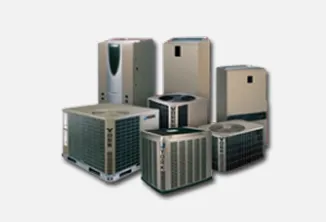
The basic types of air conditioners are room air conditioners,
split-system central air conditioners, and packaged central air
conditioners.
Room Air Conditioners
Room air conditioners cool rooms rather than the entire home.
If they provide cooling only where they're needed, room air conditioners
are less expensive to operate than central units, even though
their efficiency is generally lower than that of central air conditioners.
Smaller room air conditioners (i.e., those drawing less than
7.5 amps of electricity) can be plugged into any 15- or 20-amp,
115-volt household circuit that is not shared with any other major
appliances. Larger room air conditioners (i.e., those drawing
more than 7.5 amps) need their own dedicated 115-volt circuit.
The largest models require a dedicated 230-volt circuit.
Central Air Conditioners
Central air conditioners circulate cool air through a system
of supply and return ducts. Supply ducts and registers (i.e.,
openings in the walls, floors, or ceilings covered by grills)
carry cooled air from the air conditioner to the home. This cooled
air becomes warmer as it circulates through the home; then it
flows back to the central air conditioner through return ducts
and registers. A central air conditioner is either a split-system
unit or a packaged unit.
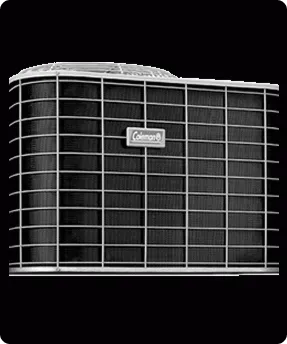
In a split-system central air conditioner, an outdoor
metal cabinet contains the condenser and compressor, and an indoor
cabinet contains the evaporator. In many split-system air conditioners,
this indoor cabinet also contains a furnace or the indoor part
of a heat pump. The air conditioner's evaporator coil is installed
in the cabinet or main supply duct of this furnace or heat pump.
If your home already has a furnace but no air conditioner, a split-system
is the most economical central air conditioner to install.
In a packaged central air conditioner, the evaporator,
condenser, and compressor are all located in one cabinet, which
usually is placed on a roof or on a concrete slab next to the
house's foundation. This type of air conditioner also is used
in small commercial buildings. Air supply and return ducts come
from indoors through the home's exterior wall or roof to connect
with the packaged air conditioner, which is usually located outdoors.
Packaged air conditioners often include electric heating coils
or a natural gas furnace. This combination of air conditioner
and central heater eliminates the need for a separate furnace
indoors.
Evaporative Coolers
An evaporative cooler (also called a "swamp cooler") is a completely
different type of air conditioner that works well in hot, dry
climates.
These units cool outdoor air by evaporation and blow it inside
the building, causing a cooling effect much like the process when
evaporating perspiration cools your body on a hot (but not overly
humid) day. When operating an evaporative cooler, windows are
opened part way to allow warm indoor air to escape as it is replaced
by cooled air.
Evaporative coolers cost about one-half as much to install as
central air conditioners and use about one-quarter as much energy.
However, they require more frequent maintenance than refrigerated
air conditioners and they're suitable only for areas with low
humidity.
Maintaining Existing Air Conditioners
Older air conditioners may still be able to offer years of relatively
efficient use. However, making your older air conditioner last
requires you to perform proper operation and maintenance.
Air Conditioning Problems
One of the most common air conditioning problems is improper
operation. If your air conditioner is on, be sure to close your
home's windows and outside doors. Other common
problems with existing air conditioners result from faulty installation,
poor service procedures, and inadequate maintenance. Improper
installation of your air conditioner can result in leaky ducts
and low airflow.
Many times, the refrigerant charge (the amount of refrigerant
in the system) does not match the manufacturer's specifications.
If proper refrigerant charging is not performed during installation,
the performance and efficiency of the unit is impaired. Service
technicians often fail to find refrigerant charging problems or
even worsen existing problems by adding refrigerant to a system
that is already full. Air conditioner manufacturers generally
make rugged, high quality products. If your air conditioner fails,
it is usually for one of the common reasons listed below:
Refrigerant Leaks
If your air conditioner is low on refrigerant, either it was
undercharged at installation, or it leaks. If it leaks, simply
adding refrigerant is not a solution. A trained technician should
fix any leak, test the repair, and then charge the system with
the correct amount of refrigerant. Remember that the performance
and efficiency of your air conditioner is greatest when the refrigerant
charge exactly matches the manufacturer's specification, and is
neither undercharged nor overcharged.
Inadequate Maintenance
If you allow filters and air conditioning coils to become dirty,
the air conditioner will not work properly, and the compressor
or fans are likely to fail prematurely.
Electric Control Failure
The compressor and fan controls can wear out, especially when
the air conditioner turns on and off frequently, as is common
when a system is oversized. Because corrosion of wire and terminals
is also a problem in many systems, electrical connections and
contacts should be checked during a professional service call.
Needed Maintenance
An air conditioner's filters, coils, and fins require regular
maintenance for the unit to function effectively and efficiently
throughout its years of service. Neglecting necessary maintenance
ensures a steady decline in air conditioning performance while
energy use steadily increases.
Air Conditioner Filters
The most important maintenance task that will ensure the efficiency
of your air conditioner is to routinely replace or clean its filters.
Clogged, dirty filters block normal airflow and reduce a system's
efficiency significantly. With normal airflow obstructed, air
that bypasses the filter may carry dirt directly into the evaporator
coil and impair the coil's heat-absorbing capacity. Filters are
located somewhere along the return duct's length. Common filter
locations are in walls, ceilings, furnaces, or in the air conditioner
itself.
Some types of filters are reusable; others must be replaced.
They are available in a variety of types and efficiencies. Clean
or replace your air conditioning system's filter or filters every
month or two during the cooling season. Filters may need more
frequent attention if the air conditioner is in constant use,
is subjected to dusty conditions, or you have fur-bearing pets
in the house.
Air Conditioner Coils
The air conditioner's evaporator coil and condenser coil collect
dirt over their months and years of service. A clean filter prevents
the evaporator coil from soiling quickly. In time, however, the
evaporator coil will still collect dirt. This dirt reduces air-flow
and insulates the coil which reduces its ability to absorb heat.
Therefore, your evaporator coil should be checked every year and
cleaned as necessary.
Outdoor condenser coils can also become very dirty if the outdoor
environment is dusty or if there is foliage nearby. You can easily
see the condenser coil and notice if dirt is collecting on its
fins.
You should minimize dirt and debris near the condenser unit.
Your dryer vents, falling leaves, and lawn mower are all potential
sources of dirt and debris. Cleaning the area around the coil,
removing any debris, and trimming foliage back at least 2 feet
allow for adequate airflow around the condenser.
Coil Fins
The aluminum fins on evaporator and condenser coils are easily
bent and can block air-flow through the coil. Air conditioning
wholesalers sell a tool called a "fin comb" that will comb these
fins back into nearly original condition.
Sealing and Insulating Air Ducts
An enormous waste of energy occurs when cooled air escapes from
supply ducts or when hot attic air leaks into return ducts. Recent
studies indicate that 10% to 30% of the conditioned air in an
average central air conditioning system escapes from the ducts.
For central air conditioning to be efficient, ducts must be
airtight. Hiring a competent professional service technician to
detect and correct duct leaks is a good investment, since leaky
ducts may be difficult to find without experience and test equipment.
Ducts must be sealed with duct "mastic." The old standby of duct
tape is many times ineffective for sealing ducts.
Obstructions can impair the efficiency of a duct system almost
as much as leaks. You should be careful not to obstruct the flow
of air from supply or return registers with furniture, drapes,
or tightly fitted interior doors. Dirty filters and clogged evaporator
coils can also be major obstructions to airflow.
The large temperature difference between attics and ducts makes
heat conduction through ducts almost as big a problem as air leakage
and obstructions. Ducts in attics should be insulated heavily
in addition to being made airtight.
Buying a New Air Conditioner for Your Home
Today's best air conditioners use 30% to 50% less energy to produce
the same amount of cooling as air conditioners made in the mid
1970s. Even if your air conditioner is only 10 years old, you
may save 20% to 40% of your cooling energy costs by replacing
it with a newer, more efficient model.
Sizing your Air Conditioners
Air conditioners are rated by the number of British Thermal Units
(Btu) of heat they can remove per hour. Another common rating
term for air conditioning size is the "ton," which is 12,000 Btu
per hour.
How Big should your Air Conditioner Be?
The size of an air conditioner depends on:
- how large your home is and how many windows
it has;
- how much shade is on your home's windows,
walls, and roof;
- how much insulation is in your home's
ceiling and walls;
- how much air leaks into your home from
the outside; and
- how much heat the occupants and appliances
in your home generate.
An air conditioner's efficiency, performance, durability, and
initial cost depend on matching its size to the above factors.
Make sure you buy the correct size of air conditioner. Two
groups—the Air Conditioning Contractors of America (ACCA) and
the American Society of Heating, Refrigerating, and Air Conditioning
Engineers (ASHRAE)—publish calculation procedures for sizing central
air conditioners. Reputable air conditioning contractors will
use one of these procedures, often performed with the aid of a
computer, to size your new central air conditioner.
Be aware that a large air conditioner will not provide the best
cooling. Buying an oversized air conditioner penalizes you in
the following ways.
It costs more to buy a larger air conditioner than you need.
The larger-than-necessary air conditioner cycles on and off more
frequently, reducing its efficiency. Frequent cycling makes indoor
temperatures fluctuate more and results in a less comfortable
environment. Frequent cycling also inhibits moisture removal.
In humid climates, removing moisture is essential for acceptable
comfort. In addition, this cycling wears out the compressor and
electrical parts more rapidly. A larger air conditioner
uses more electricity and creates added demands on electrical
generation and delivery systems.
Air Conditioner Efficiency
Each air conditioner has an energy-efficiency rating that lists
how many Btu per hour are removed for each watt of power it draws.
For room air conditioners, this efficiency rating is the Energy
Efficiency Ratio, or EER. For central air conditioners, it is
the Seasonal Energy Efficiency Ratio, or SEER. These ratings are
posted on an Energy Guide Label, which must be conspicuously attached
to all new air conditioners. Many air conditioner manufacturers
are participants in the voluntary EnergyStar® labeling program
(see Source List in this publication). EnergyStar®-labeled appliances
mean that they have high EER and SEER ratings.
In general, new air conditioners with higher EERs or SEERs sport
higher price tags. However, the higher initial cost of an energy-efficient
model will be repaid to you several times during its life span.
Your utility company may encourage the purchase of a more efficient
air conditioner by rebating some or all of the price difference.
Buy the most efficient air conditioner you can afford, especially
if you use (or think you will use) an air conditioner frequently
and/or if your electricity rates are high.
Room Air Conditioners—EER-
Room air conditioners generally range from 5,500 Btu per hour
to 14,000 Btu per hour. National appliance standards require room
air conditioners built after January 1, 1990, to have an EER of
8.0 or greater. Select a room air conditioner with an EER of at
least 9.0 if you live in a mild climate. If you live in a hot
climate, select one with an EER over 10.
The Association of Home Appliance Manufacturers reports that
the average EER of room air conditioners rose 47% from 1972 to
1991. If you own a 1970s-vintage room air conditioner with an
EER of 5 and you replace it with a new one with an EER of 10,
you will cut your air conditioning energy costs in half.
Central Air Conditioners—SEER-
National minimum standards for central air conditioners require
a SEER of 9.7 and 13.0, for single-package and split-systems,
respectively. But you do not need to settle for the minimum standard—there
is a wide selection of units with SEERs of 18.
Before 1979, the SEERs of central air conditioners ranged from
4.5 to 8.0. Replacing a 1970s-era central air conditioner with
a SEER of 6 with a new unit having a SEER of 13 will cut your
air conditioning costs more than in half.
Sound Considerations
The Sound level of the out door section may be important to you
do to the units location, or proximity to your neighbor's window.
Most units today have sound ratings that are measured in decibel
ratings.
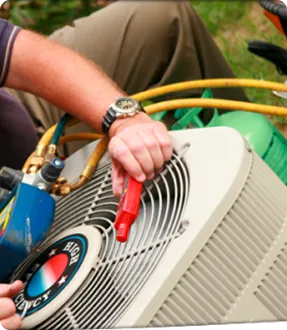
What to Look for in Professional Service
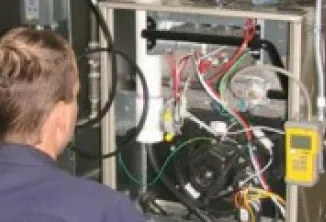
When your air conditioner needs more than the regular maintenance
described previously, hire a professional service technician.
A well-trained technician will find and fix problems in your air
conditioning system. However, not all service technicians are
competent. Incompetent service technicians forsake proper diagnosis
and perform only minimal stop-gap measures.
Insist that the Technician:
- check for correct amount of refrigerant;
- test for refrigerant leaks using a leak
detector;
- capture any refrigerant that must be evacuated
from the system, instead of illegally releasing it to the atmosphere;
- check for and seal duct leakage in any
part of your system that runs in the attic, crawl, or garage
- measure air-flow through the evaporator
coil;
- verify the correct electric control sequence
and make sure that the heating system and cooling system cannot
operate simultaneously;
- inspect electric terminals, clean and
tighten connections, and apply a non-conductive coating if necessary;
- oil motors and check belts for tightness
and wear;
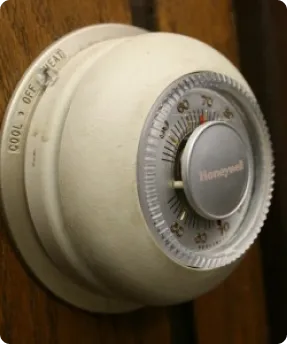
- check the accuracy of the thermostat.
How to Choose a Contractor
Choosing a contractor may be the most important and difficult
task in buying a new central air conditioning system. Ask prospective
contractors for recent references. If you are replacing your central
air conditioner, tell your contractor what you liked and did not
like about the old system. If the system failed, ask the contractor
to find out why. The best time to fix existing problems is when
a new system is being installed.
When designing your new air conditioning system, the contractor
you choose should:
- use a written calculation procedure or
computer program to size the air conditioner;
- provide a written contract listing the
main points of your installation that includes the results of
the cooling load calculation;
- give you a written warranty on equipment
and workmanship.
Avoid making your decision solely on the basis of price. The
quality of the installation should be your highest priority, because
quality will determine energy cost, comfort, and durability.
Installation and Location of Air Conditioners
If your air conditioner is installed correctly, or if major installation
problems are found and fixed, it will perform efficiently for
years with only minor routine maintenance. However, many air conditioners
are not installed correctly. As an unfortunate result, modern
energy-efficient air conditioners can perform almost as poorly
as older inefficient models.
Be sure that your contractor performs the following procedures
when installing a new central air conditioning system:
- allows adequate indoor space for the installation,
maintenance, and repair of the new system, and installs an access
door in the furnace or duct to provide a way to clean the evaporator
coil.
- uses a duct-sizing methodology such as
the Air Conditioning Contractors of America (ACCA) Manual D.
- ensures there are enough supply registers
to deliver cool air and enough return air registers to carry
warm house air back to the air conditioner.
- installs duct work within the conditioned
space, not in the attic, wherever possible – insulating it where
it must be run outside the treated structure.
- seals all ducts with duct mastic and heavily
insulates attic ducts.
- locates the condensing unit where its
noise will not keep you or your neighbors awake at night, if
possible.
- places the condensing unit in a shady
spot, if possible, which can reduce your air conditioning costs
by 1% to 2%.
- verifies that the newly installed air
conditioner has the exact refrigerant charge and air-flow rate
specified by the manufacturer.
- locates the thermostat away from heat
sources, such as windows, or supply registers.
If you are replacing an older or failed split system, be sure
that the evaporator coil is replaced with a new one that exactly
matches the condenser coil in the new condensing unit. (The
air conditioner's efficiency will likely not improve if the existing
evaporator coil is left in place; in fact, the old coil could
cause the new compressor to fail prematurely.)
If you install a new room air conditioner, try to:
- locate the air conditioner in a window
or wall area near the center of the room and on the shadiest
side of the house.
- minimize air leakage by fitting the room
air conditioner snugly into its opening and sealing gaps with
a foam weather stripping material.
Paying attention to your air conditioning system saves you money
and reduces environmental pollution. Notice whether your existing
system is running properly, and maintain it regularly. Or, if
you need to purchase a new air conditioner, be sure it is sized
and installed correctly and has a good EER or SEER rating.
Using Your Air Conditioner
Unless, your contractor has sized your air conditioner to maximize
humidity control instead of just cooling the air temperature,
an air conditioner will cool the air in your home fairly quickly.
For economical operation, turn it on only when your home is occupied.
You may consider installing a programmable thermostat. These allow
you to set the time when the air conditioner will turn on before
you arrive home from work on a hot day. Contact EREC (see Source
List) for the fact sheet Automatic and Programmable Thermostats.
During the day, keep the drapes or blinds closed on windows that
face east, south, and west. This will help reduce solar heat gain
into your home.
Source List
There are many groups offering information on air conditioning.
The following groups are just a few that can assist you in increasing
your air conditioning efficiency. Some of these organizations
provide only materials appropriate for professionals in the air
conditioning industry.
- Air Conditioning and Refrigeration Institute
(ARI) 4301 N. Fairfax Drive, Suite 425 Arlington, VA 22203 (703)
524-8800 Fax: (703) 528-3816 www.ari.org ARI represents manufacturers
of air conditioning, refrigeration, and heating equipment and
has consumer brochures on a variety of topics.
- American Society of Heating, Refrigeration,
and Air Conditioning Engineers (ASHRAE) 1791 Tullie Circle,
N.E. Atlanta, GA 30329 (404) 636-8400 Fax: (404) 321-5478 www.ashrae.org
ASHRAE is organized solely for the purpose of advancing the
arts and science of heating, ventilation, air conditioning,
and refrigeration for the public's benefit through research,
standards writing, continuing education, and publications.
- Air Conditioning Contractors of America
(ACCA) 1513 16th Street NW Washington, DC 20036 (202) 483-9370
Fax: (202) 234-4721 www.acca.org The Air Conditioning Contractors
of America is the most active and widely recognized organization
representing contractors in the heating, ventilation, air conditioning,
and refrigeration (HVACR) industry.
- EnergyStar® Program 1-888-STAR-YES e-mail:
info@energystar.gov www.energystar.gov ENERGY STAR®-labeled
products, including heating and cooling equipment, use less
energy than other products and save you money on utility bills.
These products are made by all major manufacturers and are available
at stores everywhere.
- Florida Solar Energy Center (FSEC) 1679
Clear Lake Road Cocoa, FL 32922 (407) 638-1000 Fax: (407) 638-1010
www.fsec.ucf.edu FSEC provides information on building in hot,
humid climates.
For more information about cooling and air conditioning, as
well as on a wealth of other energy-efficiency topics, contact:
- The Energy Efficiency and Renewable Energy Clearinghouse (EREC)
P.O. Box 3048 Merrifield, VA 22116 (800) 363-3732 (800-DOE-EREC)
Fax: (703) 893-0400 E-mail: doe.erec@nciinc.com www.eren.doe.gov/consumerinfo
EREC provides free general and technical information to the
public on many topics and technologies pertaining to energy
efficiency and renewable energy.
Reading List
The following publications provide more information on air conditioning.
The list does not cover all the available books, reports, and
articles on air conditioning, nor is the mention of any publication
a recommendation or endorsement.
- ASHRAE Journal, American Society of Heating, Refrigerating
and Air Conditioning Engineers (ASHRAE), 1791 Tullie Circle
N.E., Atlanta, GA 30329-2305, monthly trade magazine.
- "Consumer Guide to Home Energy Savings", A. Wilson and J.
Morrill, American Council for an Energy-Efficient Economy, 1001
Connecticut Ave. NW, Suite 801, Washington, DC 20036, 1998.
- Home Energy, The Magazine of Residential Energy Conservation,
2124 Kitteredge, #95, Berkeley, CA 94704, monthly trade magazine.
For example, the May/June 1995 issue had an article about properly
sizing air conditioning systems.
- Consumer Reports, The Consumers Union of the United States,
Inc., 101 Truman Avenue, Yonkers, NY 10703, (800) 234-1645 (subscriptions
and back issues). "Chill Out: A Guide to Air Conditioning,"
(63:6) pp. 36-42, June 1998. "Cool It (Room/Window Air Conditioners)"
(64:6) pp. 35-37, June 1999.
This document was produced for the U.S. Department of Energy
(DOE) by the National Renewable Energy Laboratory (NREL), a DOE
national laboratory. The document was produced by the Information
Services Program, under the DOE Office of Energy Efficiency and
Renewable Energy. The Energy Efficiency and Renewable Energy Clearinghouse
(EREC) is operated by NCI Information Systems, Inc., for NREL
/ DOE. The statements contained herein are based on information
known to EREC and NREL at the time of printing. No recommendation
or endorsement of any product or service is implied if mentioned
by EREC.
DOE/GO-10099-379 FS 206 June 1999
|